


You are still getting things done. But ordinary tasks take more effort than they used to, time off feels unproductive, and one more request lands like a threat. Meeting your responsibilities does not mean the current arrangement is working.
Burnout in capable adults rarely looks like collapse. More often it looks like functioning at a cost that keeps rising. People in this position usually ask me for a better coping strategy. What they often need first is a clearer view of which part of the problem is theirs to change.
Cognitive behavioral therapy (CBT) offers several techniques that help. They do different jobs, though, and choosing the wrong one can turn recovery into another demand. This guide matches each technique to the pattern it addresses, so you can start with the one that fits.
Key takeaways
- The right CBT technique for burnout depends on what is keeping you stuck: overload, self-criticism, withdrawal, difficulty starting, perfectionism, or physical tension.
- When the demands themselves are excessive, start with structured problem-solving.
- No technique makes an unsustainable workload sustainable. Recognizing that is useful information, not a failure to cope.
What burnout is, and what it isn’t
The World Health Organization describes burnout as a syndrome resulting from chronic workplace stress that has not been successfully managed. It has three features: exhaustion, growing mental distance or cynicism about your work, and a reduced sense of effectiveness. WHO classifies it as an occupational phenomenon, not a medical condition.
That definition matters for two reasons. First, exhaustion that comes from caregiving, a health problem, or a difficult season at home deserves attention, but it is not automatically occupational burnout. Second, depression, anxiety, sleep disorders, and medical conditions can look like burnout from the inside. If the picture is unclear, a professional assessment can help identify what support is appropriate.
What CBT can and can’t do for burnout
CBT techniques help you examine patterns in how you think and act under pressure: the rules you hold about responsibility, the predictions that drive overchecking, the way withdrawal feeds exhaustion. That work is real and often useful.
What CBT cannot do is make unreasonable demands reasonable. If the workload is the problem, a technique that only changes your reaction may leave the main source of pressure unchanged. The techniques below are meant to be used alongside changes to the demands when the demands are what needs to change. For more on how I approach this in therapy, see therapy for anxiety and stress.
How to choose a technique
A long list of exercises becomes one more thing to keep up with. Choose one primary technique, using these criteria:
- Pattern fit. Match the technique to the specific obstacle, not to burnout in general.
- Control. Separate what you can decide from what requires someone else’s cooperation.
- Effort. Pick something you can try without turning recovery into a project.
- Observable change. Look for a different action or decision, not an immediate change in how you feel.
Add a second technique only when it addresses a different obstacle.
| Technique | Fits when | What it can’t do |
|---|---|---|
| Structured problem-solving | Demands feel unmanageable | Create authority or resources you don’t have |
| Cognitive restructuring | Self-criticism is harsh and rigid | Replace addressing actual mistreatment |
| Behavioral activation | Life has narrowed to work and recovery from work | Substitute for assessment when withdrawal is severe |
| Graded tasks | Starting is the sticking point | Reduce the total workload |
| Behavioral experiments | Perfectionism or over-responsibility drives overwork | Be used safely where consequences are serious |
| Relaxation training | Physical bracing is prominent | Change the source of chronic stress |
Six CBT techniques for burnout
1. Structured problem-solving: for overload
Structured problem-solving turns “everything is too much” into a specific problem you can act on. The goal is not to get better at tolerating everything. It is to change one demand.
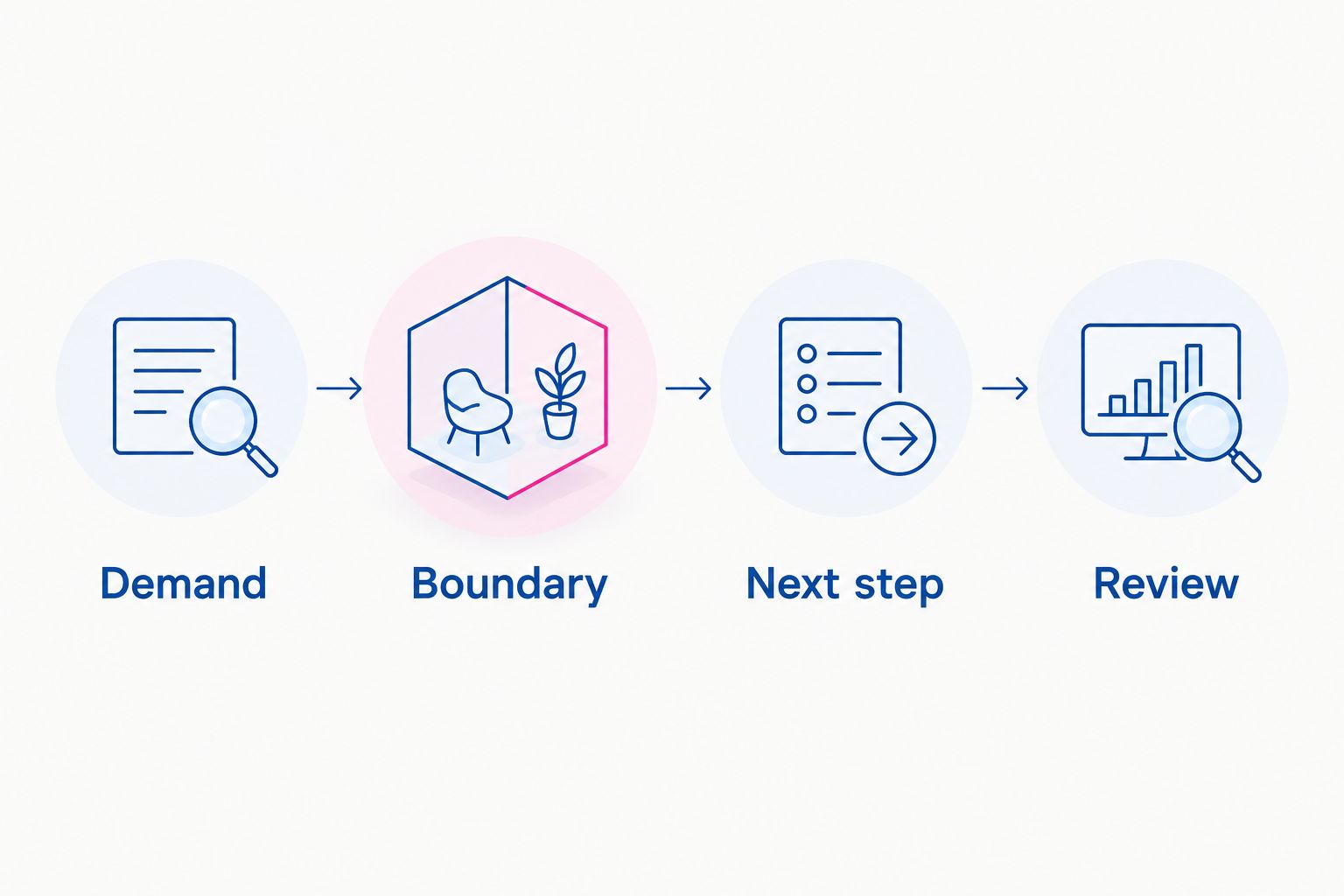
Start with one recurring pressure point and work through four steps:
- Demand. Name the specific request or responsibility causing difficulty.
- Boundary. Identify what you can decide and what needs someone else’s agreement.
- Next step. Choose one concrete action, such as asking your manager to rank competing deadlines.
- Review. Check whether the action changed the problem or revealed another obstacle.
Keep the first round short, with a clear stopping point, so the planning doesn’t become its own task.
Fits when: you know the demands are excessive but can’t see the next move. Limit: it can’t fix understaffing or unsafe conditions on its own, and it can slide into planning without deciding.
2. Cognitive restructuring: for harsh self-criticism
A missed deadline is an event. Deciding it proves you are incompetent is an interpretation. Cognitive restructuring examines that interpretation without pretending the deadline didn’t matter.
Write down the situation, your automatic thought, and the evidence for and against it. Then form a more accurate statement that points toward a practical response. If the thought is “resting means I’m irresponsible,” look at the rule underneath it. Does responsibility require constant availability, or does it include knowing your limits? An accurate response can hold both an unfinished task and a real need to stop.
If you tend to analyze endlessly, decide in advance when you will stop writing. The exercise should end in a decision, not another round of debate.
Fits when: you read limits, mistakes, or rest as evidence of personal failure. Limit: this is not positive thinking, and it is a poor substitute for addressing actual mistreatment.
3. Behavioral activation: for withdrawal
Behavioral activation is an established CBT approach, best known from depression treatment. It means scheduling small, manageable activities connected to meaning, connection, or basic functioning, rather than waiting for motivation to return first. Here it is a practical way to address withdrawal, not a cure for burnout.
Choose something you have stopped doing that matters to you: eating lunch away from your desk, calling a friend, returning to a quiet hobby. Keep it brief, with a clear endpoint. Afterward, notice whether it felt restorative, neutral, or draining, and adjust the next attempt. Completion is not a score. Rest belongs in the plan too, and filling every open space with activity defeats the purpose.
Fits when: your life has narrowed to work, obligations, and recovering from both. Limit: it can become another checklist, and it does not replace assessment when withdrawal is persistent or severe.
4. Graded tasks: for difficulty starting
Graded tasks break a difficult activity into smaller steps arranged by difficulty. Problem-solving decides what to do. This technique targets the moment you can’t begin.
“Finish the report” is broad. “Open the document and write the headings” is bounded. Choose a first step small enough to finish quickly, and decide in advance what happens after it: stop, reassess, or continue deliberately. A small start is not a trick to pull you into an unplanned evening of work.
Fits when: you know what needs doing but stall at the beginning. Limit: the total demand stays the same, so pair this with workload changes when the workload is the problem.
5. Behavioral experiments: for perfectionism and over-responsibility
Instead of debating whether something must be perfect, a behavioral experiment tests a specific prediction through a planned, safe action. If you predict that asking which task takes priority will make you look incapable, ask, and record what actually happens, including a mixed or uncomfortable result.
Write the prediction down before you act. Otherwise it is easy to move the standard afterward and decide that an ordinary response still proves you failed.
Never run an experiment by neglecting safety procedures, clinical or legal obligations, or deadlines with serious consequences. The point is to test an assumption, not to manufacture a problem.
Fits when: you overprepare, overcheck, or take responsibility for everything because you expect serious consequences otherwise. Limit: one response does not show how everyone will react, and the situation you choose has to be genuinely low-risk.
6. Relaxation training: for physical tension
Sustained stress can show up in the body: a clenched jaw, raised shoulders, shallow breathing, hands braced on the keyboard. Relaxation training addresses that strain directly. It is a skill that improves with practice, and a few simple methods are a reasonable place to start:
- Slow breathing. Breathe in gently through your nose and let the exhale run a little longer than the inhale. A few minutes is enough.
- Progressive muscle relaxation. Tense one muscle group gently for a few seconds, then release it and notice the difference. Work through your body from your feet up or your head down.
- A brief body check. A few times a day, notice where you are holding tension, such as your jaw, shoulders, or hands, and let it go. Over time, this makes it easier to release tension in the middle of an ordinary day, not only during a dedicated practice.
Practice somewhere comfortable, not while driving or doing something that requires your full attention. Don’t strain a painful or injured area. If focusing on your body increases distress, stop and choose a different approach. Relaxation is a skill to build, not an obligation to become calm on command.
Fits when: physical bracing is a prominent part of how stress shows up for you. Limit: it doesn’t change workload or workplace conditions, and body-focused work isn’t comfortable for everyone.
Where to start if you’re not sure
Start with structured problem-solving. Name the demand before deciding that your reaction to it is the problem. Then add one technique if a second obstacle is clearly present:
- Harsh internal rules: cognitive restructuring
- Withdrawal from what matters: behavioral activation
- Trouble beginning: graded tasks
- Fear-driven perfectionism: behavioral experiments
- Persistent bodily tension: relaxation training
When exercises aren’t enough
If exhaustion, disrupted sleep, low mood, or difficulty functioning persists, the next step is a professional assessment, not more exercises. A clinician can sort out whether you are dealing with burnout, depression, anxiety, a medical issue, or some combination, and whether a different treatment approach fits better.
If you are having thoughts of harming yourself, call or text 988 to reach the Suicide & Crisis Lifeline, or go to your nearest emergency room.
Frequently asked questions
A final note
An exercise can work even when what it reveals is that the demand needs to change. Identifying an impossible expectation is useful information, not evidence that you failed to cope.
Choose one pattern, one technique, and one observable next action. Keep the exercise small enough that support doesn’t become another standard you have to meet.
Therapy for burnout, anxiety, and sustained pressure
Approach Therapy provides online psychotherapy for adults experiencing anxiety, stress, burnout, and life transitions. Melanie Chinchilla, Ph.D., works with adults in California, New York, and Illinois.
In therapy, we define your goals and review progress, while addressing the practical demands in your life alongside patterns such as perfectionism, people-pleasing, and over-responsibility.
Approach Therapy is primarily a private-pay practice. See our Fees & FAQs for payment information.
Sources
World Health Organization: Burn-out an occupational phenomenon
Important information
This article is for general educational purposes and does not provide individualized clinical advice. Reading it or contacting Approach Therapy does not establish a therapist–patient relationship. Services begin after the appropriate intake process is completed and a treatment relationship is established.

